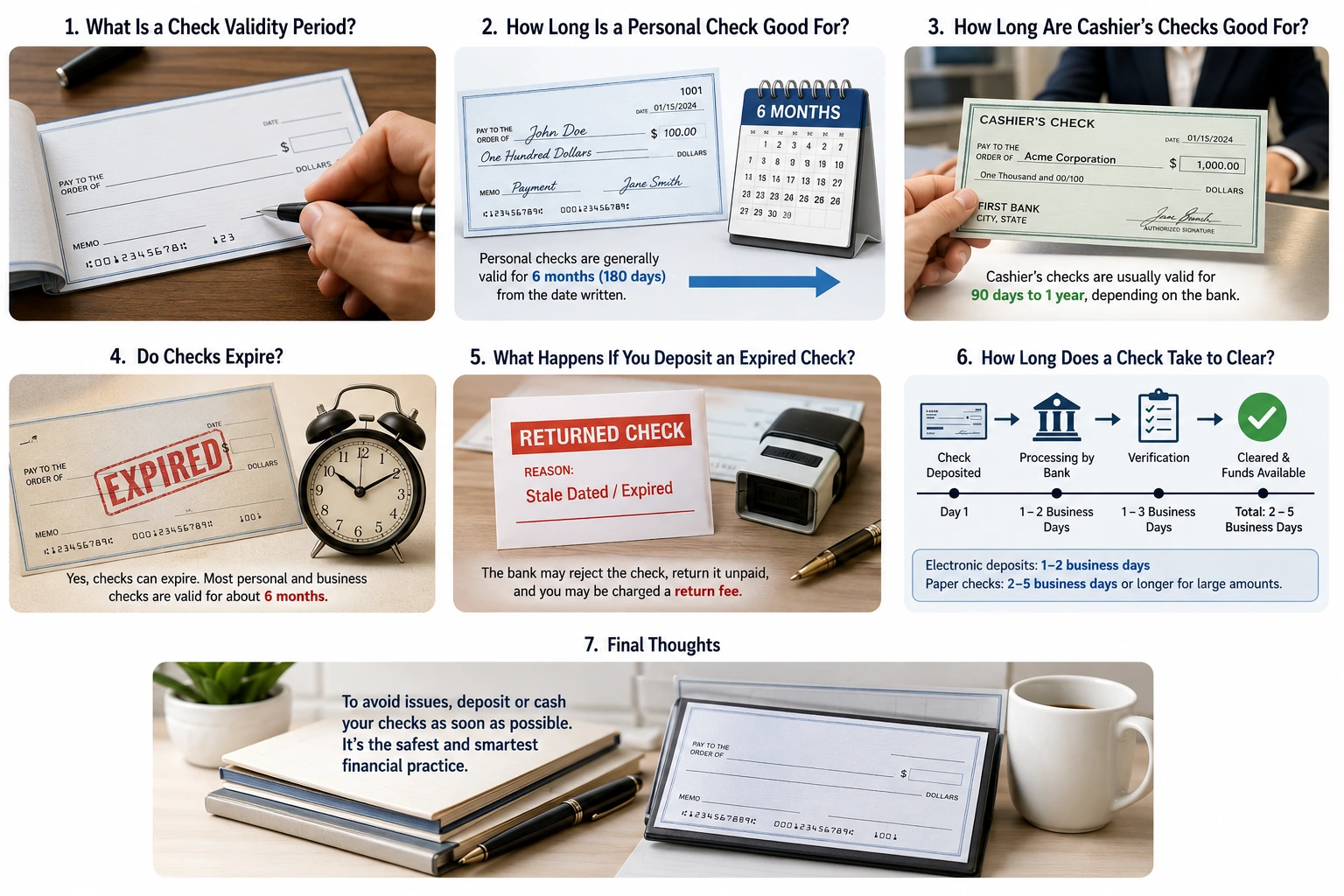
Checks are still used today in business, personal, and financial transactions. Now, a question that many are likely to ask is how long does a check actually remain valid and are checks cancelled after not being cashed?
We will make all this easy to understand, from the period of validity of checks to what happens after they expire and what you should do if you come across an old check.
What is Check Validity Period?
A check validity period is the period of time that a check may be deposited or cashed at a bank. Following this period, banks might become hesitant to accept it.
While printed checks have an expiration date in most cases, the expiration date varies depending on the type of check and banking regulations, and they are said to be “stale” or “expired” after a predetermined period.
Is a personal check valid for a specific period of time?
One of the most frequently used types of checks that are issued is a personal check.
Standard Validity Period:
Generally valid for 6 months on the date the check is written (180 days).
Key Points:
- Banks can refuse to accept it as “stale-dated” after 6 months.
- Some banks will accept older checks but it is not guaranteed.
- It is always best to cash or deposit personal checks quickly.
Related questions:
- How many months does a personal check last for? → About 6 months
- Given how many days do you have to cash a check? → within 6 months ideally.
Cashier’s checks are valid for a limited period.Cashier’s checks have an expiration date.
A cashiers check is a check made by a bank and is more secure than a personal check.
Validity Period:
The validity period ranges from 90 days to 1 year, as decided by the issuing bank.
Important Details:
- A few banks have written “void after 90 days” on the check.
- Some money can be left over even after the deadline has passed, but a reissue may be necessary.
- Expired cashier’s checks are treated with a greater level of scrutiny by banks than are personal checks.
Related questions:
- Are cashier’s checks valid for 90 days or 1 year? → Typically, yes, for up to 90 days or 1 year.
- What is the time limit on cashier’s checks? → varies from bank to bank
Do Checks Expire?
Yes, although checks may not always have an expiration date printed on them, they do expire in practice.
Why checks expire:
- Old checks aren’t safe – banks don’t trust them.
- The amount in accounts may be adjusted.
- Fraud prevention policies
Types affected:
- Personal checks → typically 6 months.
- The journey to reputation takes time for business checks, and most often, as many as six months.
- Consumable Purchases (Cashier’s checks) → 90 days to 1 year
What is the time period required to cash a check?
Most banks will advise you to cash checks within:
- 30 days (1 month) for cashier’s checks
- None for cashier’s checks (90-365 days)
What if you wait too long?
- If you submit a check, it is possible that the bank will reject it.
- It might be necessary to obtain a new one from the issuer.
- As days go by, the money may be increasingly difficult to get back.
How long to wait before cashing a check?
Technically you can hold a check any time you want, but:
- It is “stale-dated” after 6 months
- Some banks might take it, but they’re not obligated.
It’s safe to deposit checks as soon as possible.
Is there an expiry date for checks?
The typical checks will not have an obvious expiration date. However:
- They follow banking “validity rules”.
- Some cashier’s checks have a specific expiration date (for instance: 90 Days).
Yes, checks are valid according to banking standards.
Do checks “expire” if they aren’t cashed?
Yes, checks can go bad if they are not cashed in within the specified amount of time.
After expiration:
- Bank may reject the check
- Issuer will have to issue another check.
- There may be funds remaining but not available in the old check.
What if You Deposit an Expired Check?
If you attempt to deposit an expired, or stale, check:
- The bank may refuse to accept it
- It can be returned non-refundable
- In some instances a return fee may be charged.
Solution:
- Call the issuer of the check
- Ask for a new check.
Do Cashier’s Checks Expire?
Yes, cashier’s checks do expire.
Validity:
Every time you’ll get a new one for the next 90 days to 1 year.
Following expiration, banks may ask for verification/reissue of the document.
How Long Is the Average Check’s Duration?
This is a simplified explanation:
| Type of Check | Validity Period |
|---|---|
| Personal check | ~6 months (180 days) |
| Business check | ~6 months |
| Cashier’s check | 90 days – one year |
| A government check | is typically needed and may be for up to 1 year |
Do Blank Checks Expire?
Blank checks don’t “expire” in the same way, but:
- Once the account is closed, they can no longer be used.
- Your banks might not accept the old check format.
- Security features can become obsolete.
What is the time needed for a check to clear?
Should be deposited within validity:
- Electronic deposits: 1–2 business days
- Check: 0–5 business days (or longer if needed for large amounts)
May be faster to clear with bank backing – cashier’s checks.
Are Checks Ever Expiring 100%?
Yes, after all these years:
- They might not be accepted by the banks
- Funds may be returned to the issuer or escheated to the state (after many years in some cases)
May a Cashiers Check be canceled?
Yes, but there are specific conditions:
- Before it is cashed
- If lost or stolen –
- A formal cancellation request will be sent to the issuing bank.
Final Thoughts
So, how long a check is valid before it is cashed?
- Most personal checks are matured for 6 months.
- Money orders: 2 months to 1 year
- Following this, they might be invalid or need to be reissued.
The best advice is always to be safe:
When receiving checks, always make sure to deposit or cash them as soon as possible to prevent hassles.
Visit website for more info.