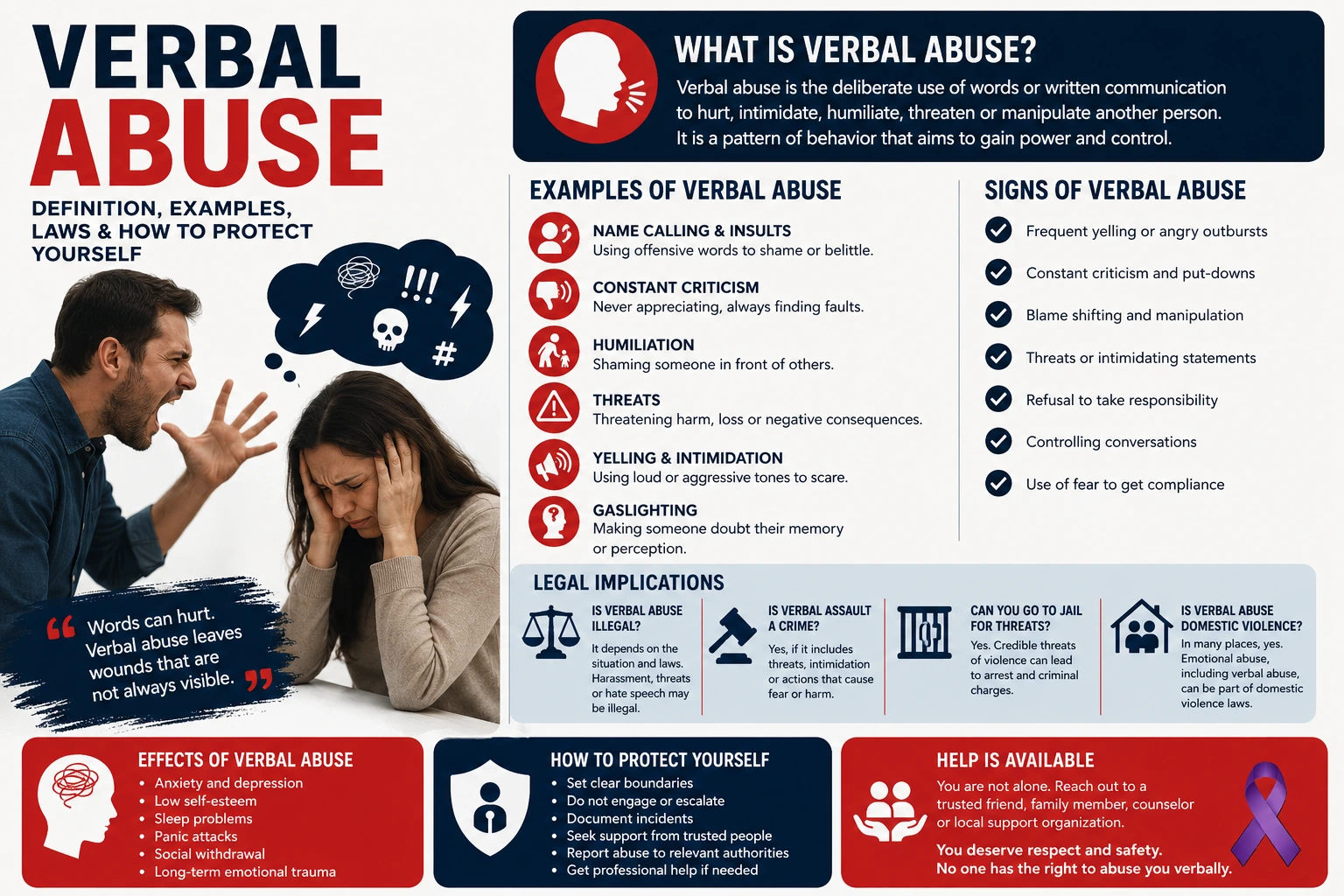
Verbal abuse is a common, yet under-recognized type of emotional abuse. It doesn’t cause physical harm, but it can be psychologically devastating and have long-term consequences. Constant criticism, insults, intimidation, humiliation and threats can cause a person to lose his or her confidence, affect his or her mental health, adversely impact his or her relationship, and impact overall well-being.
Numerous individuals suffer from verbal abuse without knowing that such abuse falls within the definition of verbal abuse. Others ask “Is verbal assault a crime?” and “Is verbal harassment illegal?” as well as criminal charges for verbal threats.
This extensive guide explores what constitutes verbal abuse, offers examples of verbal abuse, covers legal implications, and offers practical tips on how to avoid or safeguard yourself against verbal abuse.
What Is Verbal Abuse?
Verbal abuse is the deliberate, repeated use of language or writing to control, intimidate, shame, threaten or manipulate another person, or to cause the person emotional harm.
Vocal abuse is not like a healthy disagreement, nor is it a typical argument, but it is a pattern of behavior meant to obtain control over another person.
Common characteristics include:
- Constant criticism
- Insults and name-calling
- Public humiliation
- Threats
- Manipulation
- Blaming
- Yelling
- Gaslighting
- Intimidation
- Emotional blackmail
The objective is typically to make the victim feel helpless, terrified or reliant.
Verbal Abuse Definition
The practical definition of verbal abuse is:
Deliberate language which causes emotional, mental or psychological harm by insulting, threatening, intimidating, embarrassing, humiliating or by persistent degrading communication towards another person.
The abuse can take place in:
- Romantic relationships
- Marriage
- Families
- Schools
- Workplaces
- Friendships
- Public settings
- Online communication
Definition of Verbal Abuse in Everyday Life
Turning up the volume isn’t the only form of verbal abuse.
There are a lot of venomous expressions that’re given in a cool way.
Examples include:
- “You’re worthless.”
- “Nobody will ever love you.”
- “You’re in it all by yourself.”
- “You’re stupid.”
- “You’re a failure.”
Exposure to such messages repeatedly can have serious mental health consequences.
Examples of Verbal Abuse
Knowing what to look for when someone is verbally abusing others will allow them to identify abusive behaviour before it develops.
Common examples include:
Name Calling
Inappropriate and derogatory labels to shame or denigrate.
Examples:
- Idiot
- Useless
- Loser
- Lazy
- Worthless
Constant Criticism
Constantly criticizing, no matter the performance level.
Examples:
- Never do anything right.
- “You never live up to my expectations.”
Humiliation
Shaming someone in front of other people, especially family, workmates or strangers.
Threats
Threatening to harm, financial loss, relationship or career.
Yelling
Speaking too loud for the purpose of intimidation, not communicating.
Gaslighting
Putting another person on trial on their own memory or perception.To call into question a person’s memory or perception.
Examples include:
- “That never happened.”
- “You’re imagining things.”
Manipulation
Controlling someone with guilt or shame.
Silent Treatment
Deliberately withholding communication from one as a form of emotional punishment.
Mocking
Telling insults about appearance, intelligence, beliefs or abilities.
Repeated Blaming
Taking another person’s actions for granted as the cause of all problems without regard to truth.
What Is Verbal Assault?
What is verbal assault? is a question that many people ask.
A verbal assault usually consists of aggressive verbal conduct toward another person that is intended to intimidate and threaten or to cause emotional discomfort.
Certain definitions of verbal assault exist and are dependent upon jurisdiction, but the following factors are common to many:
- Threatening violence
- Intimidating language
- Aggressive confrontation
- Serious verbal threats
Verbal Assault Definition
A good definition of verbal assault is:
A dominating tone of voice that is used to terrorize, bully, or scare another person.
Verbal assault is not a simple argument; it contains words that instill fear or emotional damage.
Verbal Harassment Definition
In general, verbal harassment is considered repeated unwanted comments or messages that make a person feel like he/she is being intimidated, threatened, or made to feel uncomfortable.
It may involve:
- Repeated insults
- Offensive jokes
- Sexual comments
- Racial slurs
- Religious discrimination
- Bullying
- Persistent intimidation
Verbal harassment is the most common form of harassment and is usually experienced in a place of work or school but can also take place online or in public.
Verbal Abuse vs. Verbal Harassment
While they are frequently used as synonyms they are distinct.
Verbal Abuse – Verbal Harassment
Typically in personal relationships Often in workplaces, schools, or public places
Uses emotional regulation Repeats unwanted behaviours
May occur in isolation Typically involves the victim’s peer/situation
May manipulate Often fails to follow workplace/school policies
Verbal Abuse vs. Verbal Assault
One of the commonly asked questions is what is the difference between verbal abuse and verbal assault.
Verbal Abuse
- Ongoing pattern
- Emotional manipulation
- Psychological harm
- May happen over a period of months or years
Verbal Assault
- Typically one particularly violent incident
- Includes threats or intimidation
- May escalate quickly
- Can cause immediate anxiety
What Is a Verbal Altercation?
Verbal argumentation is when there is a disagreement among two or more people with raised voices or rough language.
A verbal altercation is not necessarily abusive; whereas verbal abuse is.
A disagreement is abusive when one person keeps trying to dominate, frighten or harm another person’s feelings.
Is Verbal Abuse Domestic Violence?
One of the common questions is whether verbal abuse is domestic violence?
Verbal abuse may be deemed to be a type of domestic abuse or emotional abuse in many jurisdictions, particularly when it is part of a pattern of coercive control, intimidation or psychological manipulation within a relationship of intimacy or in a family, household or domestic partnership.
It is not a legal requirement to be domestic violence, it depends on the laws in which the incident takes place. Emotional or psychological abuse is specifically identified in some pieces of domestic violence legislation, and in others, it must be supported by other evidence, including threats, stalking, or physical abuse.
If someone has been consistently verbally abused by a spouse, partner or family member, they should know the local domestic violence laws and seek help if they are in danger.
Is It Against the Law to Be Verbally Abused?
The question people frequently ask is, is verbal abuse illegal?
The answer will depend on the situation and on the law.
In many countries:
- There are no general insults which are criminal offenses.
- Violence can be a crime.
- Harassment is a crime and/or civil offense.
- Employment regulations are conceivable to be infringed by workplace harassment.
- There are laws that may ban hate speech.
- Emotional/psychological abuse could be covered under domestic abuse laws.
Frequent wrongful behavior may also be evidence in family court, work investigations, or civil cases.
Is Verbal Assault a Crime?
Is verbal abuse a crime?
Not all verbal confrontations are criminal. But some kinds of verbal behaviour can lead to criminal charges such as:
- When a person’s life is in danger, credible threats of violence will be made.
- Any action or intimidation meant to cause fear
- Stalking is the act of persistently threatening another person.
- Witness intimidation
- Criminal harassment
- The offense of hate crimes involving threatening language is recognized by the law,
The determination of criminal intent is dependent on local legislation and the circumstances of the incident.
Can You Go to Jail for Threatening Someone Verbally?
Another frequently asked question is can you go to jail for threatening someone verbally?
Yes, if a threat of violence is verbal, and if it is credible, it may be considered a criminal act in many jurisdictions, including the United States, with the potential for criminal consequences, particularly if the threat is made with the intent to cause fear or intimidation.
These can include threatening to:
- Kill someone
- Causing serious bodily harm upon someone.
- Engage in violent behavior
- Damage property in a manner that is in violation of criminal law
Whether criminal charges are warranted is usually a matter of opinion that is decided by the law and the circumstances of the situation and the threat.
Signs That Someone Is Verbally Abusive
A verbally abusive person’s actions are not isolated episodes of abuse but occur repeatedly.
Warning signs include:
- Frequent yelling
- Constant criticism
- Personal insults
- Humiliation
- Threats
- Blame shifting
- Manipulation
- Controlling conversations
- Refusing accountability
- The use of fear to obtain compliance
Identifying these patterns early can support people to establish boundaries and get help.
The Effects of Verbal Abuse
Verbal abuse is not seen to have an injury but it can still have a big impact.
Victims may experience:
- Anxiety
- Depression
- Low self-esteem
- Panic attacks
- Sleep disturbances
- Difficulty concentrating
- Social withdrawal
- Emotional exhaustion
- Chronic stress
- Symptoms of post traumatic stress
Children may have long-term emotional and developmental problems if they have grown up in a family where the parents are verbally abusive.
How to Handle Verbal Abuse
If you are a victim of verbal abuse, here are some tips on how to handle it.
If you feel you are being verbally abused think about these tips:
- Be non-threatening and don’t escalate the situation.
- Clearly state your boundaries.
- If you feel that you are not safe, leave.
- If relevant, record abusive messages, emails or incidents.
- Talk with family/friend members that you can trust.
- Report any harassment or bullying in the workplace/school environment through proper channels.
- If necessary, get the help of a mental health worker.
- If any threats are made towards violence, or if you feel unsafe, please contact law enforcement authorities right away.
How to Report Verbal Abuse
Documentation may be helpful if you are looking to seek legal protection or workplace action.
Consider maintaining:
- Incident journal, including dates and times, in writing.
- Emails, text messages and social media messages (copies of these).
- Voicemails containing abusive language.
- Names of witnesses.
- Employer, school or authority reports.
Ensure any recordings or evidence taken always pertain to local laws.
Frequently Asked Questions
Is It Always Verbal Abuse if It’s Shouted?
No 2. It’s possible to yell at someone during arguments, but not abuse them. If there is a repeated pattern of intimidation/humiliation/threats/emotional control, it is verbal abuse.
Is It Possible for Verbal Abuse to Take Place on the Internet?
Yes. Verbal or written abuse may include any messages, comments, emails or social media communications that are abusive or could be considered to be abusive.
Do Children Suffer Verbal Abuse?
Yes. Emotional and developmental harm can result from repeated insults, humiliation, threats or language which is degrading to children.
Is Verbal Abuse Physical Abuse?
In certain cases verbal abuse can turn into physical violence. If you feel you are in danger, get assistance from trusted people or emergency services right away.
Conclusion
Verbal abuse is a serious type of emotional abuse that can happen in relationships, families, workplaces, school or public places. It is important to understand what verbal abuse is, to know the definition of verbal abuse, to recognize examples of verbal abuse and understand the difference between verbal abuse, verbal altercation, and verbal harassment so that the person who is experiencing the abuse will be able to respond better.
There is no single answer to the questions, “Is verbal abuse domestic violence? Is verbal abuse illegal? Is verbal assault a crime? Can you go to jail for threatening someone verbally? The result of the legal action will be determined by the facts of each case and the applicable law. But when threats are credible, and criminal harassment, or coercive behavior occurs, it can have serious legal implications.
No one is to suffer a second time at the hands of another person’s emotional intimidation or degrading treatment. If you know you’re in danger, don’t hesitate to document if it’s appropriate, establish healthy limits, and reach out to trusted professionals or authorities to help keep you safe and in your rights.