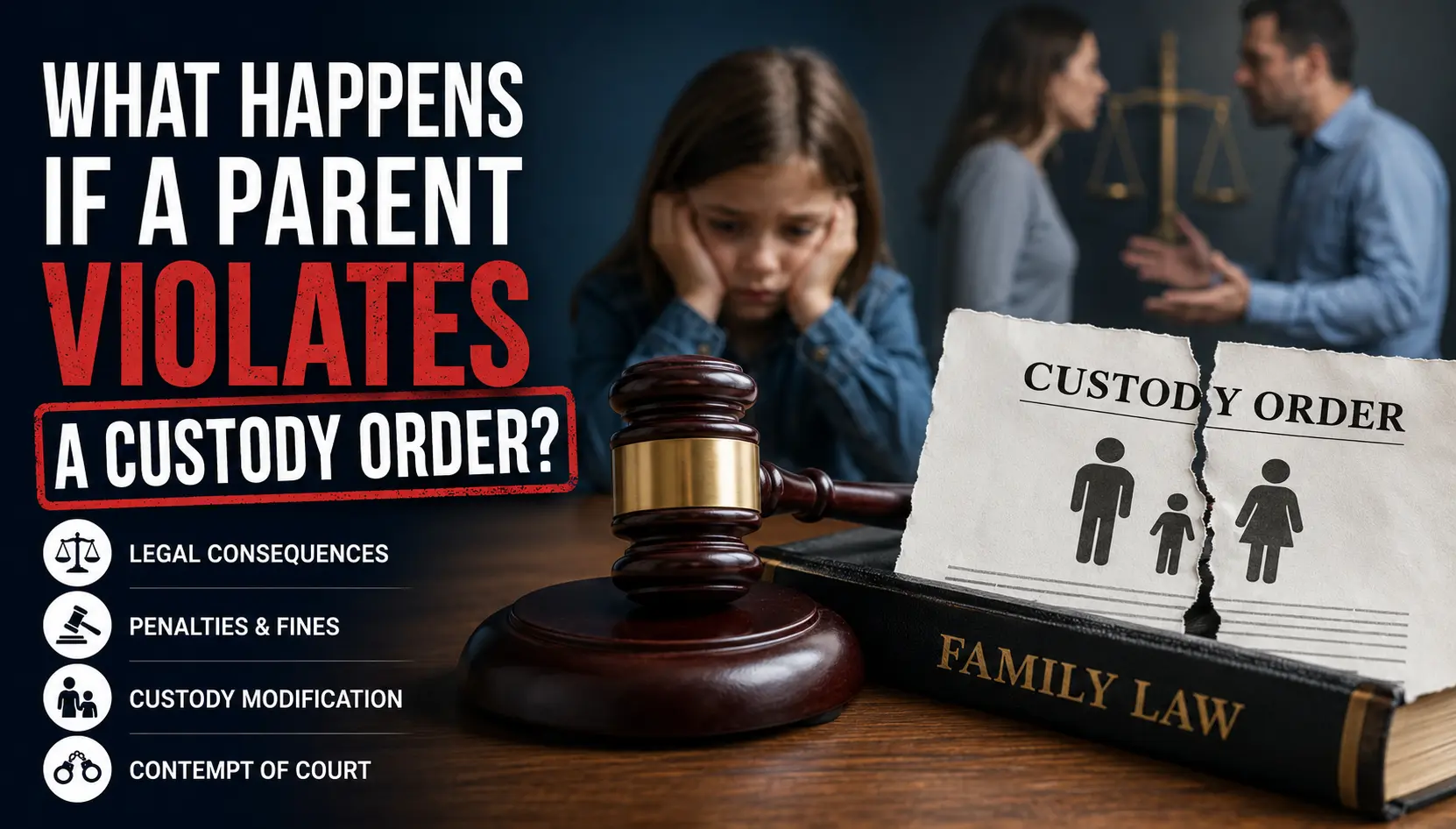
If parents separate or divorce, the purpose of child custody orders is to provide a stable, structured and protective framework for children. A court order is a binding order and both parents are expected to comply with the court order as it stands. If a parent refuses to comply with the conditions of an order, its consequences can be quite serious, both legally and emotionally.
Conflict and disruption of the child’s routine as well as harm to the co-parenting relationship can arise due to a violation of the custody order. Courts appreciate these issues because the purpose of the custody arrangements is to place the best interests of the child. Parents who break court orders can be subjected to harsh penalties, whether it’s if they refuse to allow visitation, withdraw the child, move out of the state or county without permission or repeatedly ignore the parenting schedule.
Knowing what constitutes a breach of custody, how the court would react and what legal measures can be taken is crucial for safeguarding the rights of the parent and the welfare of the child.
What is a Custody Order?
A custody order is a court order that defines the rights and responsibilities of both parents toward their child. It typically covers:
- Physical custody
- Legal custody
- Parenting time schedules
- Holiday visitation
- Transportation arrangements
- Communication rules
- Decision-making authority
Once the order is approved by the court, it is put into practice by law. Parents cannot make the change without a court order.
Either parent can file a lawsuit if the other parent refuses to obey the conditions of the custody agreement.
Common Types of Custody Order Violation.Common Custody Order Violation Cases.
There are numerous ways a violation of custody agreement can occur. There are some violations which are minor and isolated, and others which are continuous and deliberate.
Common examples include:
Refusing Visitation
One parent refuses the other to have parenting time, for no valid reason.
Child Late:
Rewarded with a -10 rating.
Child Late: -10 awarded.
If the child is absent on several occasions at the same time, it could be deemed a refusal.
Taking the Child Without Permission
Taking the child out of the state or country without permission or judge’s orders may result in severe legal ramifications.
Ignoring Communication Rules
It is possible that blocking phone calls, refusing video chats or interfering with the communication between the child and the other parent could be in violation of court orders.
Parental Alienation
It will affect future custody decisions if a parent tries to create animosity towards the other parent, or harms the relationship intentionally.
The practice of not following decision-making authority.The habit of not obeying decision-making authority.
Where one parent has legal rights to authorize medical treatment, education or religious upbringing, the other parent cannot ignore those rights.
Frequent or intentional violations of court orders will lead to court action.
Explain why courts take custody violations seriously.Discuss why courts take custody violations seriously.
The welfare, safety and stability of the child is a top priority in the family court. Custody orders are not recommendations. They are decisions that are legally binding.
When a parent repeatedly engages in violating court order behavior, it can:
- Emotionally harm the child.
- Create instability in the child’s routine
- Increase parental conflict
- Break trust of parents to children
- Interfere with healthy development
Repeated violations are considered to be proof that the parent may not be in the best interest for the child.
What If a Parent Breaks an Order of Protection?
This will be based on the degree of the offence, whether the offence was deliberate or not and whether this is a repeat offence.
There are various consequences of court-ordered penalties relating to child custody that a court can impose.
Contempt of Court
If a parent fails to comply with an order of custody, they can be held in contempt of court. It is when the judge finds that the parent intentionally disregarded a court directive.
The consequences of a contempt can be:
- Fines
- Court fees
- Mandatory parenting classes
- Community serviceIn extreme cases, correctional time is to be imposed.
A contempt finding is a part of the legal record and can affect future custody decisions.
Changes to Custody Arrangements for Children and Young People.
If a parent continues to defy court orders, the judge may change the custody arrangements.
The result is that this may lead to:
- Reduced visitation rights
- Supervised visitation
- Involvement in a split.Loss of the right to co-parent.
- The primary parent’s custody will be given over to the other parent.
The goal of courts is to keep children away from further conflict and instability.
Loss of Parenting Time
Judges may give the parent who missed out on the parenting time as a result of the violation the make-up parenting time.
If, for instance, a parent refuses to allow visitation more than once on purpose, the court could increase the other parent’s visitation time.
Monetary Penalties
If a parent breaches the terms of the custody agreement, he or she can be ordered to pay:
- Attorney fees
- Court costs
- Travel expenses
- Losses of money resulting from the violation
These penalties are typical for intentional interference.
In extreme cases, criminals will face criminal charges.
Some custody violations may become criminal cases.
Examples include:
Parental kidnapping
Concealing the child
Violating protective orders
Undertaking a journey across state boundaries without authorization with the child.
In extreme cases, law enforcement may be called in right away.
If you are a victim of a court-ordered violation, here are some steps you can take.
When the other parent doesn’t follow the court order, many parents are wondering how to report it.
Typically, the steps taken include documenting the violation and filing a motion with the family court.
Step 1: Document Everything
Maintain accurate records such as:
- Prioritize dates and times of violations.Focus on dates and times of violations.
- Missed exchanges
- Text messages
- Emails
- Witness statements
If applicable, report to the police.
When there’s good documentation, it’s a pattern of misconduct.
The next step in the process is to read the Custody Order.
Make sure to read the exact wording of the custody arrangement. The written order is crucial in court proceedings to establish when the violation took place.
Step 2: File a Motion With the Court
The affected parent can file a motion for:
- Contempt
- Enforcement
- Modification of custody
- Immediate assistance in case the child is in danger
The court will set a time for a hearing to allow the parents to present evidence.
Step 4: Go to the Hearing
The judge hears the case at the hearing to see if the parent knowingly disregarded the order.
Possible outcomes include:
- Warnings
- Penalties
- Custody modifications
- Additional restrictions
May a Parent Prove to be in Righteousness to Violate a Custody Order?
There may be limited circumstances in which it would be appropriate for a parent to temporarily refuse compliance.
Examples may include:
- Immediate risk to child’s welfare
- Abuse concerns
- Medical emergencies
- Unsafe living conditions
Nevertheless, parents are advised to take action immediately rather than on their own in the long term.
It’s left up to the judge to decide if the actions were justified.
The process for determining custody violation cases.
There are a number of important factors which are considered by judges:
There are two types of violations.Violations are intentional or accidental.
A small scheduling mix-up is handled differently than if it’s intentional.
Frequency of Violations
Multiple infractions are more serious than a single infraction.
Impact on the Child
Emotional/psychological damage to the child is a key consideration in court.
Parental Cooperation
Parenting that promotes positive co-parenting relationships is preferred by judges.
History of Compliance
Documented cases of disobedience or obedience of court orders can have a significant impact on the decision.
Is it possible to legally have Custody Orders altered?
Yes. Parents are not allowed to make changes to the custody schedule without a formal agreement.
If there are changes to the circumstances, a parent may file a petition with the court asking for a change because:
- Relocation
- Any changes to work schedules.
- Child’s educational needs
- Health concerns
- Safety issues
If you wish to modify the terms of the custody order, it’s always better to do so in a legal way than to just break the order.
The impact of Custody Violations on Children
Children are often the biggest victims when parents do not enforce custody agreements.
The negative effects could be:
- Anxiety
- Emotional stress
- Confusion
- Behavioral problems
- Academic struggles
- Loyalty conflicts
Routine and consistency are important to courts because children thrive on having known routines and a healthy relationship with their parents.
When parents find themselves repeatedly in violation of custody agreement situations, they may eventually lose favor in family court.
How to Avoid a False Charge?
Often, during high conflict custody issues, false allegations of breach of court orders can occur.
To protect yourself:
- Keep written records
- Save communication logs
- Use parenting apps
- Follow the instructions precisely
- Be on time at exchanges
- Communicate respectfully
When it comes to custody battles, documentation can be the most powerful tool in one’s arsenal.
Family Law Attorneys are the best people to contact when it seems it is the proper time.
The lawyer’s advice is particularly critical when:
The other parent ignores the order time and time again.
You are accused of breaching the custody terms.
The child’s safety is at risk
In the event of emergency, it is necessary to make changes in the custody.
Efforts to enforce have been unsuccessful
An experienced lawyer will be able to collect evidence, file motions, and present a solid case in court.
Final Thoughts on Violating Court Order Consequences
Custody orders are designed to ensure consistency, to protect children and alleviate conflict between parents. Both parents are responsible to strictly comply with these orders as they are expected to do so. Parents who commit to a violation of court order behavior may be subjected to harsh legal penalties, such as fines, modifications to custody and other rights, and/or charges of contempt.
If it is something as small as scheduling problems or a major breach of custody order, it’s crucial to take action early. These disputes are decided based on the evidence, documentation and best interests of the child.
Parents who value cooperation, communication and following the rules are much more likely to keep their rights to their children and keep healthy relationships with them.
Ultimately, compliance with custody orders is not only legal. it’s about ensuring the emotional health and future happiness of the child.